We buy skid steers
Sell Your Skid Steer
Wheeled and tracked — priced on lift geometry, hydraulic flow, and what the tracks or tyres have left.
- Written offers
- Transport arranged
- Running or not
- California
On this page
MachineryBarn buys used skid steer loaders and compact track loaders — wheeled and tracked, running or not. Two specification details move the number on this category more than anything else and both are routinely left out of listings: whether the lift is radial or vertical, and whether the machine has high-flow auxiliary hydraulics. The first decides what the machine is good at; the second decides which attachments it can run at all, which decides who wants it.
What counts as a skid steer
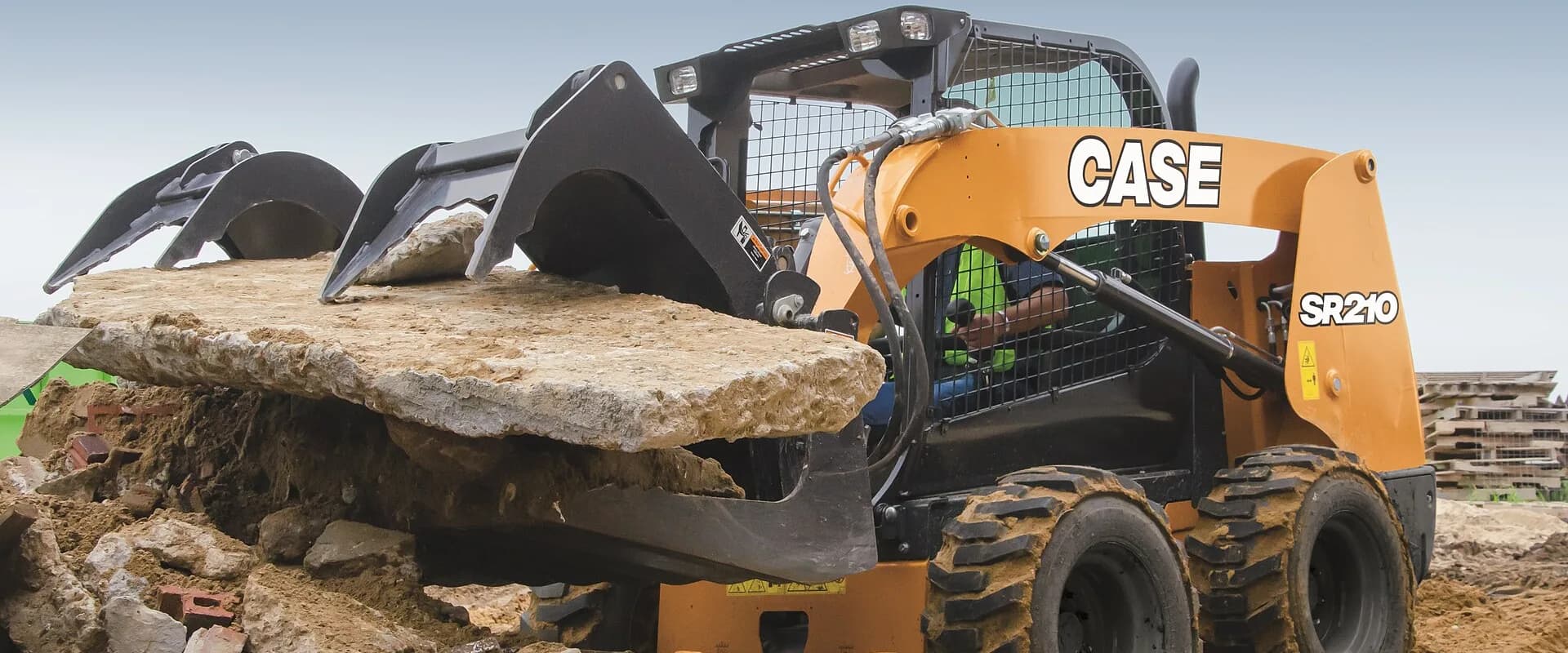
A skid steer loader is a compact machine with a rigid frame and lift arms, steered by driving the left and right sides at different speeds — the skid that gives it the name. A compact track loader is the same machine on rubber tracks instead of wheels. Both take the same universal quick-attach plate, which is why the attachment ecosystem is the largest of any equipment category.
Skid steers are classed by rated operating capacity, which is a fixed fraction of the machine's tipping load — conventionally half the tipping load on a wheeled machine and a little over a third on a tracked one. That difference is why a tracked machine and a wheeled machine with the same rated capacity are not the same size of machine. The 1,750 to 2,200 lb capacity band is the busiest part of the used market.
Where these machines usually come from
- Site cleanup, material handling and general contracting
- Landscaping and hardscape installation
- Agriculture and livestock operations, where they run year-round
- Snow removal and grounds maintenance
- Demolition and interior work on the smaller classes
- Rental fleet duty, which is where many used machines originate
Skid Steers we buy
Configuration changes who the next buyer is, so it changes the offer. These are the variants worth naming when you describe your machine.
- Wheeled skid steer
- Cheaper to run, easier on hard surfaces, and far cheaper to re-shoe than a tracked machine. The default for yard, farm and paved work.
- Compact track loader
- Rubber tracks for flotation on soft ground. More capable in mud and on slopes, and more expensive to keep — tracks and undercarriage are the dominant running cost.
- Radial lift
- The arms follow an arc. Strongest reach at mid-height, which suits digging, grading and general dirt work.
- Vertical lift
- The arms rise closer to vertical. Better reach and capacity at full height, which suits loading trucks and placing pallets. Usually the more sought-after configuration on larger machines.
What determines a used skid steer's value
Roughly in order of how much each one moves the number.
- 1
Auxiliary hydraulic flow
The single most overlooked value factor on this category. Standard flow runs most attachments; high flow is required for mulchers, cold planers, large brush cutters and snow blowers. A high-flow machine reaches a whole class of buyers that a standard-flow machine simply cannot serve.
How to check it: High-flow machines usually carry a decal near the couplers and a selector in the cab. If you are not sure, the serial plate or the original spec sheet will say.
- 2
Radial versus vertical lift
Not a better-or-worse distinction, but it decides the buyer. Vertical lift generally commands more on larger machines because loading and pallet work is where the money is; radial holds its own for dirt work.
- 3
Tracks or tyres
On a compact track loader the tracks and the undercarriage beneath them are the dominant wear cost, and buyers price the remaining life closely. On a wheeled machine tyres are a much smaller number, which is part of why wheeled machines depreciate more gently.
How to check it: On tracks: lug depth, cracking, exposed cord, and roller and idler seal weep. On tyres: remaining tread and whether the set matches.
- 4
Rated operating capacity
Sets what the machine can lift and therefore what work it can take. Larger-capacity machines have a broader commercial buyer pool; the smallest machines compete with compact excavators for the same jobs.
- 5
Cab enclosure, heat and air conditioning
An enclosed cab with working climate control is worth a clear premium, particularly on machines that will work through a Central Valley summer. An open ROPS machine is a seasonal machine to most buyers.
- 6
Control pattern and type
Pilot or electro-hydraulic joystick controls with a selectable ISO and H pattern are worth more than mechanical hand-and-foot controls, because they suit a wider pool of operators.
- 7
Two-speed travel
A small feature buyers ask about specifically. It makes a real difference on larger sites and is worth listing if fitted.
- 8
Attachments and quick-attach condition
The universal attach plate is the whole point of this machine class. Buckets, forks, augers, grapples and breakers all add value, and a worn or damaged attach plate is a real deduction because it affects every attachment the machine will ever run.
How usage is measured
Engine hours. Read them alongside what the machine was doing: a skid steer that has spent its life running a hydraulic breaker, a mulcher or a cold planer has worked its hydraulics far harder than one that has carried pallets, even at the same hour reading.
What gets inspected on a skid steer
Knowing what a buyer looks at lets you describe the machine accurately the first time, which avoids the offer changing later.
Lift arms and pins
Play at the arm, cylinder and attach-plate pins; cracks at the arm welds; and whether the grease points have been used.
Quick-attach plate
Wear at the wedge pockets, bent top hooks, and whether the locking levers hold firmly.
Tracks and undercarriage, on a CTL
Lug depth, cracking, exposed cord, sprocket wear, roller and idler seal weep, and correct track tension.
Drive system
On wheeled machines, chaincase noise and axle seal leaks. On tracked machines, final drive noise and gear oil condition.
Hydraulics
Boom and bucket drift under load, cycle times, coupler condition, and leaks around the auxiliary lines at the arm.
Cab and safety
Seat belt and seat bar interlock function, door and glass condition, air conditioning, and whether the lift interlock actually prevents operation when disengaged.
Wear items that dominate cost on this class
What we need to price your skid steer
You do not need all of it to start. The more of it you have, the closer the first number is to the final one.
- Make, model and serial number
- Year and hour meter reading
- Wheeled or tracked
- Radial or vertical lift, if you know it
- Standard or high-flow auxiliary hydraulics
- Cab or open ROPS, and whether the air conditioning works
- Track or tyre condition, or when they were last replaced
- Every attachment included in the sale
- Whether the machine came out of a rental fleet
- Whether it starts, drives and lifts
Common situations
The circumstances that come up most often when someone sells a skid steer, and what each one actually means for the sale.
The tracks are worn out on a compact track loader
Do not replace them to sell. A set of tracks plus the undercarriage work underneath is one of the larger bills on this machine class, and you will not recover it in the sale price. Describe the condition accurately instead — buyers price a known-worn undercarriage more generously than an unknown one.
You are not sure whether it is high flow
Worth establishing before you sell, because it materially changes the offer. Look for a decal near the rear couplers, a high-flow selector in the cab, or check the serial number against the manufacturer's build sheet. If it genuinely cannot be determined, say so and we will price it as standard flow.
The machine has been running a mulcher or a breaker
Tell us. Attachment-heavy work loads the hydraulics far harder than the hour meter implies, and it is the first thing an inspection would look for anyway. Being upfront gets you a firmer number rather than a provisional one.
It will not start or will not drive
Still bought, and skid steers are one of the more liquid non-running categories because the parts market is deep. Say which system stopped — engine, drive, or hydraulics — rather than diagnosing it.
You have a machine and a pile of attachments
List them all, including the ones you think are worthless. Attachments frequently make the difference between two identical machines, and a full attachment package is easier to place than a bare machine.
Moving a skid steer
Straightforward. A skid steer or compact track loader travels on a deck-over or tag trailer, and nothing in this class needs oversize permits. Machines that will not drive are winched on, which is routine as long as we know beforehand. The ease of moving these machines is part of why they hold value — the buyer pool is not limited by geography the way it is for larger iron. Transport is arranged and paid for by us and is already inside the offer.
Ownership and paperwork
Skid steers are not titled in California. Ownership transfers by bill of sale against the serial number, which is usually stamped on the frame near the loader arm pivot and repeated on a plate in the cab. Financing is common on this class because the purchase price suits equipment loans, and it normally appears as a UCC filing rather than on a title. Any payoff is settled as part of the purchase.
Attachments and extras
This category lives or dies on attachments. Buckets, pallet forks, augers, grapples, breakers, brush cutters, mulchers, trenchers, snow blowers and sweepers all count and all should be listed. Note which attachments need high flow — a mulcher included with a standard-flow machine is worth listing separately, because it will not run on the machine it came with.
Makes and model families we see most
We buy skid steers from manufacturers beyond this list. These are the ones that come up most often, with the series a seller is likely to recognise from the machine.
| Manufacturer | Model families |
|---|---|
| Bobcat | S-series wheeled and T-series tracked — S64, S76, T66, T76, T86 |
| Caterpillar | 236, 246, 262, 272 wheeled; 259, 279, 289, 299 tracked |
| John Deere | G-series — 318G, 324G, 330G wheeled; 331G, 333G tracked |
| Case | SV and SR series wheeled; TV and TR series tracked |
| New Holland | L and C series |
| Kubota | SSV wheeled and SVL tracked |
| Takeuchi | TL series tracked loaders |
| Gehl | R and V series |
| ASV | RT and VT series posi-track machines |
| JCB | Side-entry single-arm Teleskid and standard skid steers |
Get a cash offer
Get an offer on your skid steer
Tell us what you have and what shape it is in. We come back with a cash figure in writing.
- A written offer, not an estimate
- Transport arranged and priced into the offer
- Running or not, any make
Prefer to talk it through?
(916) 740-7755Get a Cash Offer
Any brand, any condition, any hours.
- Written offer
- Transport arranged
- No Spam
Where we buy skid steers
We buy across California. Our published town-level coverage is concentrated in these counties.