We buy attachments
Sell Your Attachment
Buckets, breakers, grapples, couplers and heads — priced on mount standard, hydraulic requirement and wear.
- Written offers
- Transport arranged
- Running or not
- California
On this page
MachineryBarn buys used equipment attachments — buckets, couplers, breakers, grapples, augers, mulching heads, forks and thumbs. Attachments are valued differently from machines because they only have value to someone whose carrier can mount and power them. Coupler standard and hydraulic requirement decide the buyer before condition does: a high-flow mulching head is worthless to a standard-flow machine no matter how good it is. Tell us the mount and the flow and everything else follows.
What counts as an attachment
An attachment is a tool that mounts to a carrier machine — an excavator, skid steer, loader, telehandler or backhoe — and is powered either mechanically or by the carrier's hydraulics. Mounting standards vary by machine type and size class, and hydraulic attachments require a specific flow and pressure to work correctly.
Attachments are matched to carrier size class, not sold universally. An excavator bucket is specified by the machine tonnage class and the pin dimensions; a skid steer attachment is specified by the universal attach plate and the required hydraulic flow; a loader bucket by capacity and coupler type. The class match is the first thing a buyer checks.
Where these machines usually come from
- Extending what a single carrier machine can do
- Demolition and concrete breaking, on hammers and shears
- Land clearing and vegetation management, on mulchers and grapples
- Material handling, on forks, grapples and clamps
- Utility work, on augers and compaction plates
- Fleet and rental inventory, where attachments are stocked separately
Attachments we buy
Configuration changes who the next buyer is, so it changes the offer. These are the variants worth naming when you describe your machine.
- Buckets
- Digging, ditching, grading, skeleton and rock buckets. Specified by width, capacity and the pin or coupler standard they mount on.
- Couplers and quick attach
- Pin grab, wedge and hydraulic couplers. Genuinely valuable because they make a machine attachment-capable, and they must match both machine and attachment.
- Hydraulic breakers and hammers
- Specified by carrier weight class and required flow. Chisel and bushing wear plus the internal condition decide value.
- Grapples and thumbs
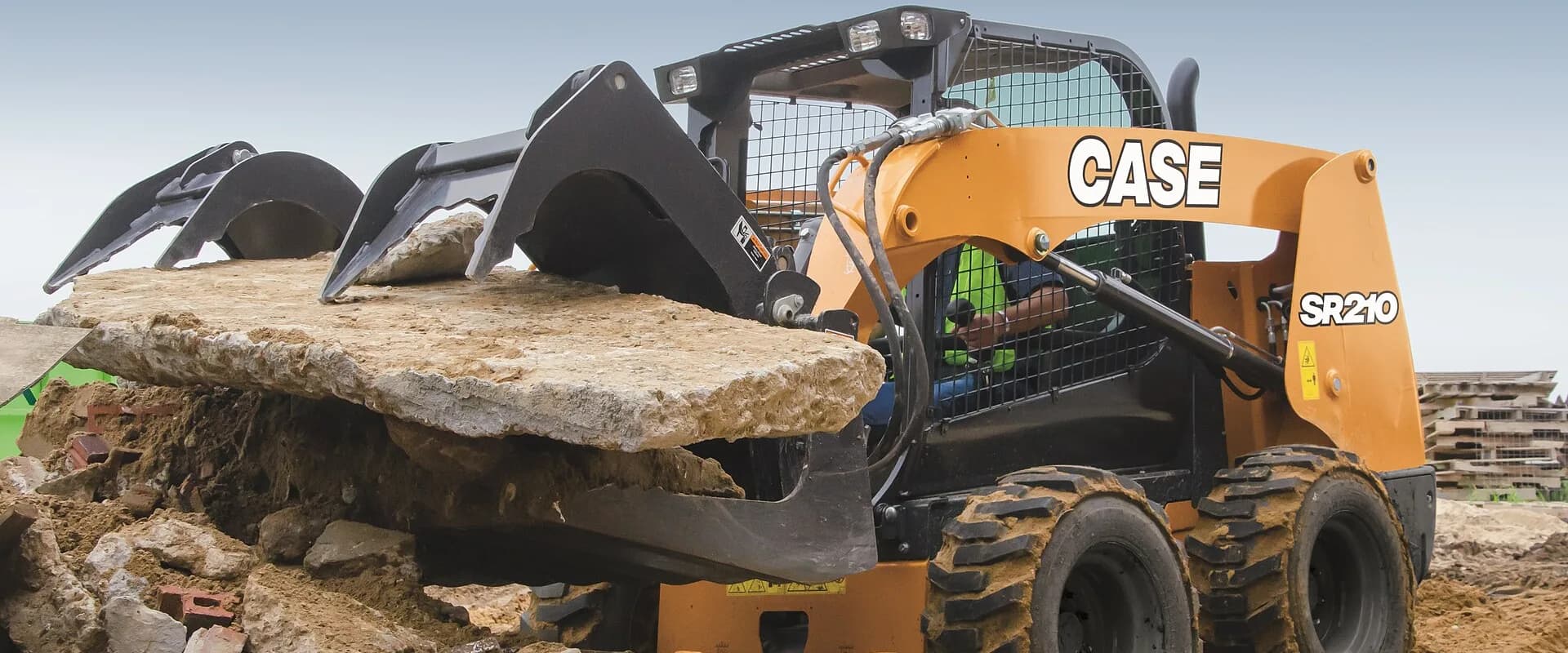
- Demolition and sorting grapples, log grapples, hydraulic and mechanical thumbs. Widely wanted and easy to place.
- Mulching heads, augers and specialist tools
- High-value items with specific flow requirements. A mulching head can be worth more than a small carrier machine.
What determines a used attachment's value
Roughly in order of how much each one moves the number.
- 1
Mount standard and carrier match
The first and most consequential question. An excavator bucket fits a pin size and width; a skid steer attachment fits the universal plate; a loader attachment fits a specific coupler. An attachment with no realistic carrier match is worth scrap, and a common attachment on a popular standard is easy to place.
How to check it: Measure pin diameter and the distance between pin centres on excavator attachments. Note the coupler type on loader and skid steer tools.
- 2
Hydraulic flow and pressure requirement
Decisive on powered attachments. Standard-flow and high-flow skid steer attachments serve different machines entirely, and an excavator breaker needs a specific flow for its carrier class. State the requirement if you know it.
- 3
Wear on the working surfaces
Cutting edges, teeth and adapters on buckets; chisel and bushings on breakers; tips and rotator on grapples; teeth or knives on mulching heads. These are the consumables and they are priced directly.
How to check it: Check cutting edge thickness, tooth and adapter condition, and whether any wear parts are missing rather than merely worn.
- 4
Structural condition
Cracked bucket ears, bent grapple tines, damaged breaker housings and cracked mounting brackets are structural rather than consumable, and they are what separates a usable attachment from a repair project.
How to check it: Look closely at the mounting ears and any welded joints, especially where the attachment takes shock loading.
- 5
Internal condition on hydraulic attachments
Breakers, augers and heads have internal components that wear invisibly. A hammer that will not fire, or fires weakly, needs a rebuild — a real cost that has to be reflected.
- 6
Completeness
Hoses, couplers, mounting brackets, control kits and any adapters are what make an attachment usable on arrival. A hammer without its bracket and hoses is a considerably smaller sale than the same hammer complete.
- 7
Brand and parts availability
Attachments from established manufacturers are easier to place because parts and service exist. Obscure or imported attachments with no parts support are harder to sell regardless of condition.
- 8
Quantity and grouping
Attachments sell better in groups than singly. A full set for one carrier class — bucket, coupler, thumb and breaker — is easier to move than four unrelated items.
How usage is measured
Attachments rarely have meters, with the exception of some hydraulic breakers and heads. Value comes from wear condition and from the carrier match. If the attachment does have an hour meter, give us the reading; otherwise describe the wear.
What gets inspected on an attachment
Knowing what a buyer looks at lets you describe the machine accurately the first time, which avoids the offer changing later.
Mounting interface
Pin bore wear and elongation, ear cracks, attach plate wear and straightness, and coupler locking function.
Working surfaces
Cutting edge and tooth condition, adapter wear, tine and tip condition, and drum or knife wear on heads.
Hydraulic components
Hose and fitting condition, cylinder rod and seal condition, motor function, and leaks at every joint.
Breaker-specific
Chisel and bushing wear, tie rod condition, whether it fires and with what force, and nitrogen charge where accessible.
Structure
Cracks at stress points, prior weld repair, bent or twisted members, and mounting bracket integrity.
Completeness
Hoses, couplers, brackets, control kits, spare teeth, and any manuals or spec sheets.
Wear items that dominate cost on this class
What we need to price your attachment
You do not need all of it to start. The more of it you have, the closer the first number is to the final one.
- Attachment type, make and model
- What carrier machine it came off — make, model and size class
- Mount standard — pin size and spacing, or coupler type
- Hydraulic requirement, standard or high flow, if powered
- Width or capacity where applicable
- Wear condition of the working surfaces
- Whether hoses, couplers and mounting brackets are included
- Whether it works, if hydraulic
- How many attachments you have in total
- Where they are stored and whether they can be loaded
Common situations
The circumstances that come up most often when someone sells an attachment, and what each one actually means for the sale.
You have a pile of attachments and no machine
Very common after a fleet is sold. Photograph the mounting interface of each one and note what machine it came off. Attachments without a stated carrier match are hard to price and hard to place, and the mount is more useful information than the brand.
You do not know what it fits
Measure it. On excavator attachments, pin diameter and the distance between pin centres are enough to identify the carrier class. On skid steer attachments, the universal plate is standard, so the question becomes hydraulic flow. A few measurements turn an unsellable item into a priceable one.
The hammer does not fire
Still bought. Breakers are rebuilt routinely and there is an active market for cores. Say whether it fires weakly or not at all, and whether the chisel and bushings are worn — those are different repair positions.
You are selling the machine and the attachments together
That is generally the better outcome. Attachments are worth more with a matched carrier than separately, because the buyer gets a working combination rather than a compatibility problem. List everything with the machine.
The attachments are obsolete or off an old machine
Worth telling us plainly. Attachments for machines no longer common have a thin market and are sometimes worth more as steel than as tools. That is not a reason not to sell — it is a reason to set expectations accurately.
Moving an attachment
Attachments are collected on a flatbed or deck-over trailer and usually loaded by forklift or by the carrier machine they came off. Large heads and breakers need lifting equipment, so tell us the approximate weight and whether anything on site can lift them. Groups of attachments are far more efficient to collect in one visit than individually. Transport is arranged and paid for by us and is inside the offer.
Ownership and paperwork
Attachments are not titled. Ownership transfers by bill of sale, and serial numbers exist on most manufactured attachments even though they are easy to overlook. If an attachment was financed as part of a machine purchase, it may sit under the same UCC filing as the carrier — worth checking before selling separately.
Attachments and extras
For this category the attachment is the item. What matters instead is the supporting equipment: mounting brackets, hose kits, in-cab control kits, spare teeth and chisels, adapters and any documentation. An attachment sold complete with everything needed to fit it is worth meaningfully more than a bare tool.
Makes and model families we see most
We buy attachments from manufacturers beyond this list. These are the ones that come up most often, with the series a seller is likely to recognise from the machine.
| Manufacturer | Model families |
|---|---|
| Caterpillar | Work tools across excavator, loader and skid steer ranges |
| Bobcat | Skid steer and mini excavator attachment range |
| Paladin | Buckets, couplers and specialty attachments |
| Werk-Brau | Buckets, thumbs and couplers |
| Stanley | Hydraulic breakers and demolition tools |
| NPK | Hydraulic hammers and compactors |
| Fecon | Mulching heads and forestry attachments |
| Danuser | Augers and specialty attachments |
Get a cash offer
Get an offer on your attachment
Tell us what you have and what shape it is in. We come back with a cash figure in writing.
- A written offer, not an estimate
- Transport arranged and priced into the offer
- Running or not, any make
Prefer to talk it through?
(916) 740-7755Get a Cash Offer
Any brand, any condition, any hours.
- Written offer
- Transport arranged
- No Spam
Where we buy attachments
We buy across California. Our published town-level coverage is concentrated in these counties.